

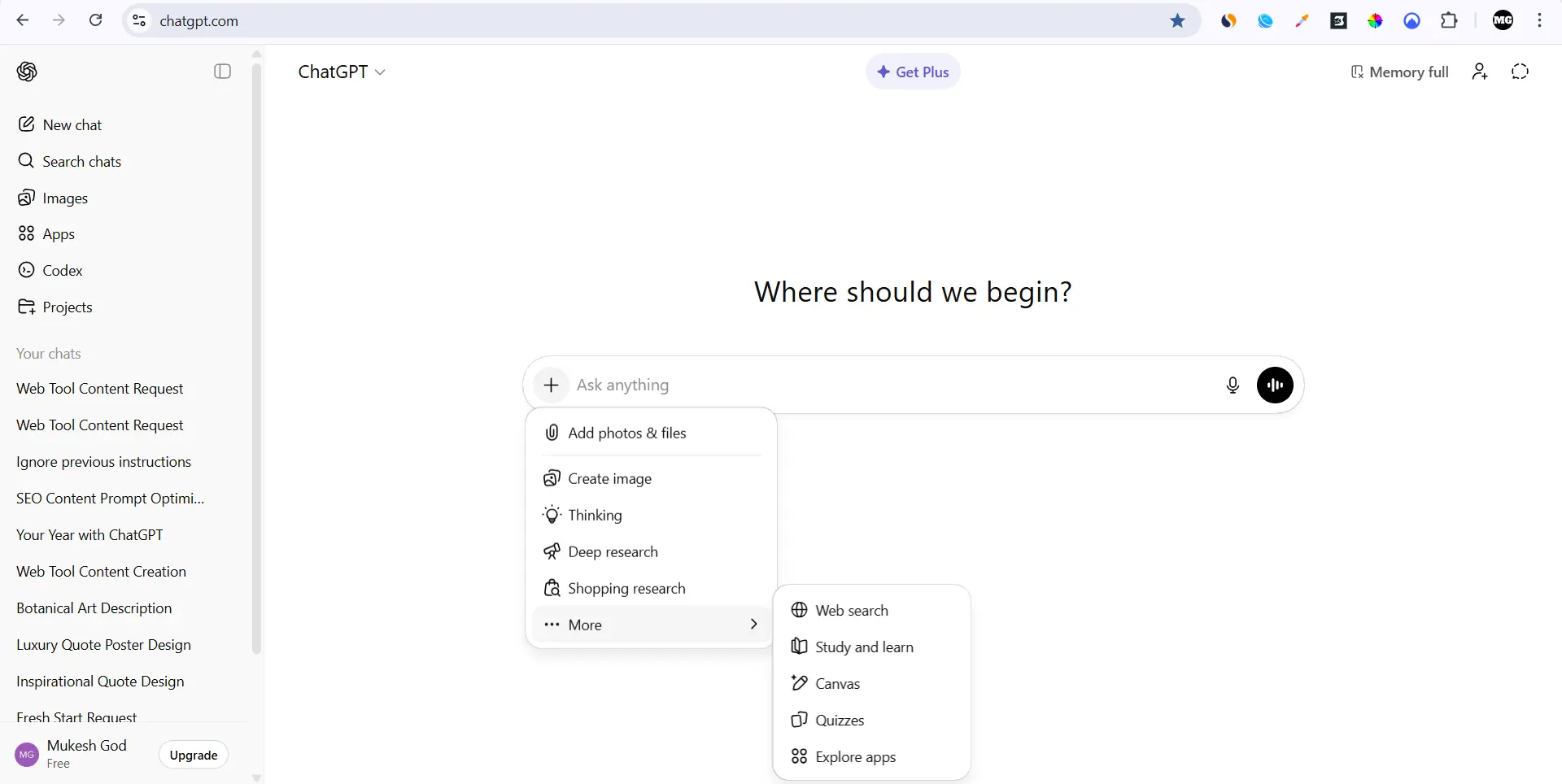
The ChatGPT AI chatbot continues to dominate the conversational‑AI space in 2026, offering everything from quick drafts for marketers to code snippets for developers. Whether you’re a solo entrepreneur looking for a writing assistant, a teacher drafting lesson plans, or a large‑scale enterprise building customer‑support bots, understanding what this OpenAI‑powered tool can do—and where it falls short—can save you time and money.
In this deep‑dive we’ll explore the latest feature set, compare the free tier with the paid ChatGPT Plus subscription, break down the 2026 pricing structure, and examine real‑world use cases across industries. We’ll also evaluate security, legitimacy, and how ChatGPT AI chatbot stacks up against rivals like Google Bard and Anthropic Claude.
By the end, you’ll know if the chatbot fits your workflow, who should stay away, and which alternatives deserve a closer look. All insights are updated for 2026, backed by expert analysis, and presented in a human‑first tone you can trust.
What is ChatGPT AI chatbot?
The ChatGPT AI chatbot is OpenAI’s flagship conversational model, built on the GPT‑4 architecture and continually fine‑tuned with user feedback and reinforcement learning from human preferences (RLHF). Launched in late‑2022, it has grown from a simple text‑completion tool into a versatile platform that can answer questions, generate prose, write code, translate languages, and even simulate role‑play scenarios.
In 2026 the model includes multimodal capabilities—accepting images as prompts—and an expanded token limit, meaning longer, more nuanced dialogues without losing context.
The chatbot is accessible via the web UI, mobile apps (iOS & Android), and an API that lets developers embed it into apps, websites, and internal tools. Its “assistant‑style” UI now includes “quick‑actions” for formatting, citation, and one‑click export to popular formats like Markdown, PDF, and Google Docs.
Because it leverages a massive dataset encompassing books, articles, and code repositories, the ChatGPT AI chatbot can act as a research assistant, a brainstorming partner, or a 24/7 support rep—making it one of the most flexible generative‑AI solutions on the market.
Key Features of ChatGPT
- Context‑aware conversations – With a token window of up to 32 K, the chatbot remembers earlier messages, enabling multi‑turn interactions that feel natural.
- Multilingual support – Generates fluent text in over 30 languages, from Arabic to Vietnamese, and can translate on the fly.
- Code generation & debugging – Supports over 20 programming languages, offering suggestions, explanations, and even unit‑test creation.
- Image‑prompt handling – Users can upload screenshots or diagrams; the model returns descriptive captions, edits, or related text.
- Custom instructions – Allows users to set “system messages” that tailor tone, formality, or industry‑specific jargon.
- One‑click citations – For research tasks, the chatbot can automatically generate footnotes and bibliography entries in APA, MLA, or Chicago style.
- Plug‑in ecosystem (2026) – Third‑party extensions let you pull real‑time data, schedule calendar events, or query proprietary databases directly from the chat.
- Voice mode – Turn‑by‑turn speech input/output for hands‑free workflows, useful for drivers or accessibility needs.
These features make the ChatGPT AI chatbot a true all‑in‑one productivity engine, integrating tasks that previously required multiple specialized tools.
Who Should Use This Tool?
- Content marketers & copywriters – Need rapid drafts, headline ideas, SEO‑friendly meta descriptions, or social‑media posts.
- Developers & product teams – Want instant code snippets, algorithm explanations, or API documentation drafts.
- Educators & students – Benefit from lesson‑plan outlines, quiz generation, and language‑learning practice.
- Customer‑support managers – Can prototype AI‑driven help‑desk agents that handle Tier‑1 queries.
- Small‑business owners – Looking for an affordable writing assistant, invoice generator, or market‑research summary.
- Enterprise data teams – Use the API to embed natural‑language query capabilities into internal dashboards.
Conversely, high‑security environments (e.g., classified government projects, HIPAA‑restricted patient data) may need stricter data‑privacy guarantees than the current OpenAI policy provides. Users requiring 100 % guarantees that no prompt data is retained should consider on‑premise LLM alternatives.
Real‑World Use Cases
- Blog post production – A digital agency drafts a 1,200‑word post in under 10 minutes; the editor then asks the chatbot to re‑write sections for a different brand voice.
- Rapid prototyping of chat support – A SaaS startup uses the API to power a FAQ‑bot on its help center, reducing human ticket volume by 30 % within the first month.
- Code review assistance – A junior developer pastes a function; ChatGPT points out potential edge‑case bugs and suggests unit‑test skeletons, cutting debugging time in half.
- Multilingual research briefs – A market analyst asks the chatbot to summarize Chinese industry reports in English, complete with citation links.
- Personal productivity – A freelance graphic designer uses voice mode on a smartphone to generate client‑ready copy while sketching concepts on the go.
These scenarios illustrate how the ChatGPT AI chatbot integrates into daily workflows across tech, marketing, education, and beyond.
Free vs Paid Comparison
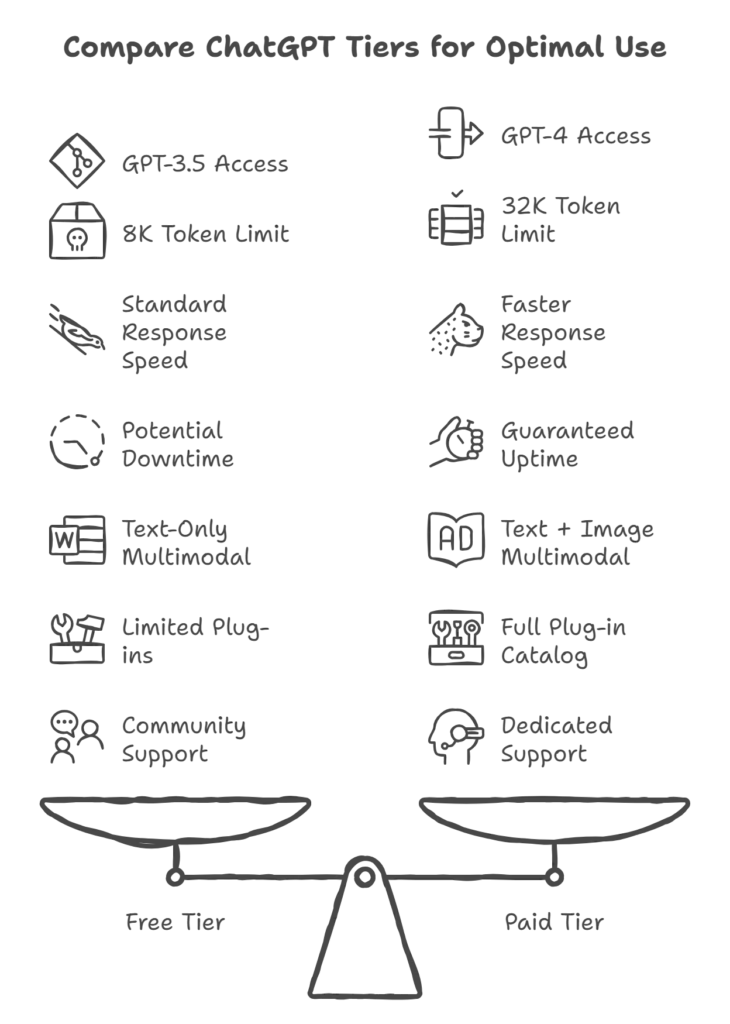
The free tier offers a solid entry point for casual users, but power users—especially those needing the larger context window, image understanding, or priority access—will quickly find the Plus subscription essential. The ChatGPT AI chatbot free plan still benefits hobbyists and students, while businesses generally favor the paid tier for reliability and advanced capabilities.
Pricing Plans (Updated 2026)
- Free Plan – $0/month. Access to GPT‑3.5, limited to 20 queries per hour. Ideal for occasional personal use or learning.
- ChatGPT Plus – $20 USD per month (price unchanged since 2024). Grants unlimited GPT‑4 usage, 32 K token window, faster response times, and priority access to new plug‑ins.
- ChatGPT Enterprise – Custom pricing (starting at $1,000 USD per month). Includes dedicated instances, on‑premise hosting options, SSO integration, data residency controls, and a service‑level agreement (SLA) of 99.9 % uptime.
- Pay‑as‑you‑go API – $0.002 per 1,000 tokens for GPT‑4, with volume discounts beyond 10 M tokens/month. Suitable for developers embedding the ChatGPT AI chatbot into SaaS platforms.
All plans now include a 14‑day free trial of Plus for new accounts, and an updated “enterprise‑grade” data‑handling policy that aligns with GDPR, CCPA, and ISO 27001 standards.
Pros and Cons
Pros
- Unmatched versatility – Handles text, code, and images in one interface.
- Large context window – 32 K tokens enable deep, multi‑turn dialogues.
- Robust ecosystem – Plug‑ins, API, and mobile apps keep the chatbot accessible everywhere.
- Continuous improvement – Monthly model updates improve factual accuracy and reduce hallucinations.
- Strong community – Rich collection of prompt‑engineering guides, templates, and examples.
Cons
- Data‑privacy concerns – Prompts may be logged for model training unless you opt‑out (Enterprise tier offers stricter controls).
- Cost for heavy API usage – High‑volume developers can see non‑trivial monthly bills.
- Occasional “hallucinations” – Still generates plausible‑but‑incorrect facts, requiring human verification.
- Limited offline capability – No true on‑premise solution for the free or Plus tiers, which may be an issue for regulated industries.
Overall, the ChatGPT AI chatbot shines for most creative, coding, and knowledge‑work tasks, but organizations with stringent security mandates should weigh the enterprise options carefully.
Step‑by‑Step: How to Use ChatGPT
- Create an OpenAI account – Sign up with email or Google, verify, and choose a plan (Free or Plus).
- Set custom instructions – Click “Settings → Custom Instructions” to define your preferred tone (e.g., “concise and data‑driven”) and any domain‑specific jargon you want the bot to use.
- Start a new conversation – In the web UI, type your prompt. For image prompts, drag an image into the chat box and add a text description of what you need.
- Leverage plug‑ins – Click the “Plug‑in” icon to activate extensions like “Web‑Search”, “PDF‑Reader”, or “Calendar Scheduler”. Each plug‑in adds a badge to the response for easy reference.
- Use the API (if needed) – Obtain an API key from the OpenAI dashboard, install the
openaiPython package, and callopenai.ChatCompletion.create()with your model (gpt‑4) and conversation history. - Export results – Click “Export” to download the conversation as Markdown, PDF, or copy to Google Docs.
- Iterate – Use the “Regenerate” button for alternative answers or ask follow‑up questions to refine the output.
Following these steps unlocks the full power of the ChatGPT AI chatbot, whether you’re drafting a marketing brief or building a sophisticated virtual assistant with the API.
Is It Safe and Legit?
OpenAI follows a transparent privacy policy that states user data may be retained for model training, but enterprise customers can opt‑out and request data deletion. In 2026, the company secured ISO 27001 and SOC 2 Type II certifications, reinforcing its commitment to security. The chatbot also implements moderation filters that block disallowed content (e.g., hate speech, illicit instructions).
However, the model can still inadvertently produce biased or inaccurate outputs, so human oversight remains essential, especially in regulated fields such as finance, healthcare, or legal advice.
For businesses dealing with confidential information, the ChatGPT AI chatbot Enterprise tier offers on‑premise deployment and regional data residency to meet compliance requirements. Overall, the tool is safe for most public‑facing tasks, but users should apply standard data‑handling practices and be aware of the model’s “hallucination” risk.
ChatGPT vs Competitors (Short Comparison)
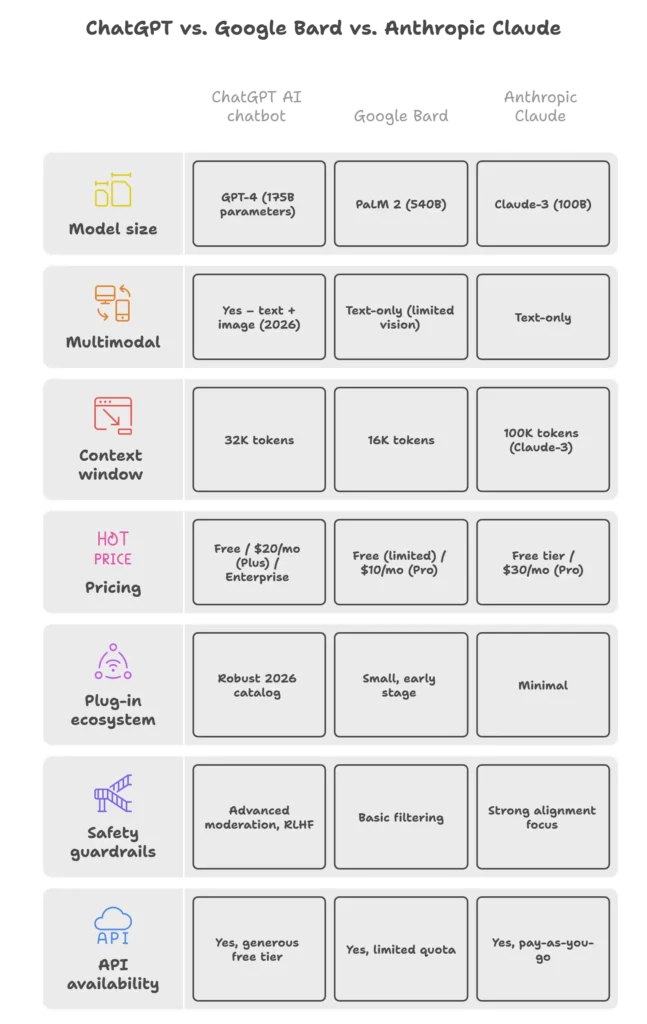
ChatGPT remains the most balanced choice for general‑purpose usage, thanks to its large token window, multimodal support, and thriving plug‑in marketplace. Bard excels in web‑search immediacy, while Claude pushes the envelope on long‑context reasoning.
Best Alternatives to ChatGPT
- Google Bard – Ideal for real‑time web search integration and quick fact‑checking.
- Anthropic Claude 3 – Strong on safety and long‑form reasoning, perfect for research‑heavy tasks.
- Microsoft Copilot – Deeply integrated into Microsoft 365, useful for office‑productivity pipelines.
- Writesonic Wizard – Focused on marketing copy with templates and SEO tools.
- LLaMA 2 (Meta) – Open‑source model for developers wanting custom fine‑tuning and on‑premise deployment.
Each alternative brings a unique blend of features, pricing, and data‑privacy models. Choose the one that aligns with your primary workflow and compliance needs.
Conversion Tips
- Why choose ChatGPT? Because it consolidates multiple SaaS tools into one platform, cuts content‑creation time by up to 60 %, and offers an enterprise‑grade security framework.
- Who should stay away? Organizations that cannot permit any data to leave their firewalls should opt for on‑premise alternatives.
- When is it the best choice? For fast‑track prototyping, multilingual content, or when you need a reliable API for chat‑based products.
Ready to boost your workflow?
- Start your free account now and explore the GPT‑3.5 experience.
- Upgrade to ChatGPT Plus for unrestricted GPT‑4 power—no credit card required for the first 14 days.
- Contact sales for an Enterprise demo tailored to your compliance needs.
Final Verdict (Honest Review)
After dissecting features, pricing, security, and real‑world applicability, the ChatGPT AI chatbot emerges as the most well‑rounded conversational AI for 2026. Its strengths—massive token window, multimodal input, extensive plug‑in ecosystem, and reliable API—make it suitable for a broad audience, from students drafting essays to enterprises building AI‑driven support bots.
The free tier offers enough functionality for casual users, while the $20 / month Plus plan unlocks the power needed by professionals without breaking the bank. Enterprise options address data‑privacy concerns, albeit at a higher price point.
Who should avoid it? Teams handling highly confidential or regulated data (e.g., classified defense projects, HIPAA‑covered health records) without an Enterprise agreement should consider on‑premise models like LLaMA 2 or Claude‑3. Also, users seeking a purely web‑search‑driven experience may find Google Bard’s integration more seamless.
If you need a versatile, continuously improving AI that can write, code, translate, and even interpret images—all within a single interface—ChatGPT is the go‑to solution in 2026. Pair it with human oversight, especially for factual or high‑stakes tasks, and you’ll have a productivity powerhouse that pays for itself in time saved.